
Vacatures
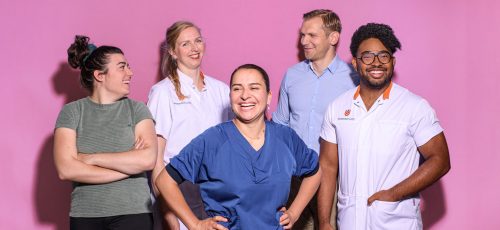
Alzheimercentrum Amsterdam is het diagnostiek- en behandelcentrum voor dementie, met als focus dementie op jonge leeftijd. Onze missie is dementie bespreekbaar en behandelbaar te maken en uiteindelijk te genezen. Met ruim 100 medewerkers is ons centrum onderdeel van de afdeling Neurologie van Amsterdam UMC, locatie VUmc. Ons team bestaat uit diverse disciplines georganiseerd rondom patiëntenzorg en wetenschappelijk onderzoek op het gebied van dementie.
Onder leiding van prof. dr. Wiesje van der Flier, wetenschappelijk directeur en prof. dr. Yolande Pijnenburg, neuroloog en medisch directeur wordt er hoogstaand klinisch wetenschappelijk onderzoek gedaan door onze onderzoekers. Dit alles om de zorg voor de patiënt van morgen te kunnen verbeteren.
Vacatures
Kijk op de website Werken bij Amsterdam UMC voor alle vacatures van Amsterdam UMC. Staat er op dit moment geen passende vacature voor je bij? Meld je aan voor de vacaturemail van Amsterdam UMC, locatie VUmc om op de hoogte te blijven van de nieuwste vacatures.
Hieronder vind je een overzicht van de vacatures bij Alzheimercentrum Amsterdam:
Promotieplek Arts-onderzoeker klinische neuropathologie
Promovendus ELEKTRA-studie: hersenstimulatie bij ziekte van Alzheimer
Wetenschappelijke stages
Are you interested in a scientific internship at Alzheimer Center Amsterdam? We create opportunities for excellent Master students!
Requirements
- A relevant Master Study, preferably Neurosciences, Medical Science or Human Health & Life Sciences
- Strong motivation to perform scientific research
- Evidence of excellence; for instance good grades or publications.
- Excellent mastery of the English language both in spoken and written form.
Applying?
Please apply by sending the following documents to stagebureau-alzheimercentrum@amsterdamumc.nl:
- Motivational letter, including:
- A motivation why you want to intern in Alzheimer Center Amsterdam;
- In which period and for what period of time you are available;
- Whether you are applying to a specific vacancy: https://www.alzheimercentrum.nl/patienten/over-ons-centrum/vacatures/
- Resume
- Scholarly report
- Bachelor thesis
Additional information:
We primarily conduct clinical scientific research, which may not meet the requirements of all study programmes. Applicants seeking a specific type of internship, please clearly state your preference as a header of your email. We will help to redirect your application to the most suitable research group or laboratory head.
- For laboratory-based research or proteomic data analysis: the Neurochemistry Laboratory
- For imaging-oriented research (not necessarily clinical): the Department of Radiology and Nuclear Medicine
Questions you can address to stagebureau-alzheimercentrum@amsterdamumc.nl; please place the word “question” in the subject of the email.
Please note that incomplete applications will not be taken into consideration. We do not offer clinical internships.
Het FINGER-NL onderzoek
De FINGER-NL studie onderzoekt hoe leefstijlinterventies kunnen bijdragen aan het verbeteren van de hersengezondheid en het voorkomen van cognitieve achteruitgang bij ouderen. Deze studie, onderdeel van het nationale MOCIA project, bouwt voort op eerdere bevindingen uit Finland (de FINGER studie) waaruit bleek dat een combinatie van lichaamsbeweging, gezond dieet, goede controle van de hart- en vaatgezondheid en geheugentraining het denkvermogen van ouderen kan verbeteren. De FINGER-NL studie bundelt allerlei leefstijlfactoren tot een tweejarige multi-domein leefstijlinterventie. Met de resultaten van het onderzoek kunnen we gerichter leefstijladvies geven, met als doel het denkvermogen van ouder te verbeteren.
Het LIGHT onderzoek
De LIGHT studie onderzoek het effect van een (op maat gemaakte) leefstijlinterventie bij mensen met geheugenklachten, specifiek gericht op risicogroepen zoals patiënten met subjectieve of milde cognitieve klachten. Deze personen hebben namelijk een verhoogd risico om dementie te ontwikkelen. Het doel van dit onderzoek is om te kijken of een persoonlijk leefstijlprogramma van 12 maanden zinvol is. Gezien is er momenteel geen preventief zorgaanbod is voor deze groep mensen, is het uiteindelijk doel van dit onderzoek om het leefstijlprogramma in de dagelijkse zorg te kunnen gebruiken.
Taken als stagiair
Als stagiair ben je betrokken bij deze twee leefstijlinterventies en zal je onder begeleiding zelfstandig je (master)thesis schrijven. De taken die gaat uitvoeren zijn:
- Werving van deelnemers voor het LIGHT onderzoek;
- Het begeleiden van deelnemers tijdens de onderzoeksdagen;
- Het helpen verzamelen en nauwkeurig verwerken van de onderzoeksgegevens zoals voedings-, en slaapdagboeken en andere vragenlijsten;
- Ondersteuning bieden in de communicatie met de deelnemers;
- Je zult onderzoek doen met bestaande data van FINGER-NL, SCIENCe, NUDAD of nl.
Profiel student
- Masterstudent Neuroscience, Klinische Neuropsychologie, Gezondheidswetenschappen of Geneeskunde of gerelateerde studies;
- Een reeds afgeronde Bachelorstage is een pré;
- Beheersing van de Nederlandse taal;
- Goede communicatieve vaardigheden.
De startdatum van de stage is in overleg. Het gaat om minimaal 5 à 6 maanden 32 uur in de week.
Voldoe je aan het profiel en heb je interesse? Stuur je CV en motivatiebrief op naar light@amsterdamumc.nl.
Onderzoek naar de vroegste veranderingen van de ziekte van Alzheimer
Werkomgeving
Alzheimercentrum Amsterdam is opgericht ten dienste van patiëntenzorg en patiëntgebonden wetenschappelijk onderzoek naar verschillende vormen van dementie. Met ruim 70 medewerkers zijn wij onderdeel van de afdeling Neurologie van Amsterdam UMC. Het team bestaat uit diverse disciplines en is gericht op zorg en onderzoek op het gebied van dementie. Onder leiding van prof. dr. Wiesje van der Flier en prof. dr. Yolande Pijnenburg, directeurs van Alzheimercentrum Amsterdam, doen we hoogstaand klinisch wetenschappelijk onderzoek, waarbij jonge gedreven onderzoekers de handen ineenslaan met ervaren stafleden. In een persoonlijke en betrokken werkklimaat streven wij naar topklasse patiëntenzorg en onderzoek van wereldformaat. Voor één van de onderzoeken van het Alzheimercentrum, de SCIENCe-studie, hebben wij steeds plaats voor één fulltime student Neuropsychologie.
De SCIENCe-studie
SCIENCe is een prospectief cohortonderzoek waarin een grote groep mensen met geheugenklachten, zonder duidelijke verklaring voor deze klachten, gevolgd wordt in de tijd. Hiervoor worden de deelnemers één keer per jaar gezien door een arts, neuropsycholoog en verpleegkundige. In dit onderzoek proberen we de allereerste veranderingen in de hersenen op te sporen en onderzoeken we of deze samenhangen met latere achteruitgang van het geheugen.
Werkzaamheden
Het is een wetenschappelijke stage waarbij de stagiaire ook neuropsychologisch onderzoek afneemt en uitwerkt. De begeleiding van het wetenschappelijke deel wordt gedaan door een onderzoeker van het SCIENCe team en van het neuropsychologische deel door Amber Natzijl.
Als stagiair zijn je belangrijkste taken en verantwoordelijkheden:
- het opstellen van een onderzoeksvraag, toegespitst op subjectieve geheugenklachten;
- het schrijven van een onderzoeksverslag volgens de richtlijnen van de Wetenschappelijke Stage;
- poliklinisch deelnemers van het onderzoek zien, vragenlijsten afnemen, neuropsychologisch onderzoek uitvoeren onder supervisie van de neuropsycholoog-onderzoeker;
- resultaten van de deelnemers bespreken in het MDO met de arts, verpleegkundige en neuroloog;
- invoer van gegevens in de database;
- ondersteuning bieden bij de coördinatie en planning van de studie;
- ondersteuning bieden bij de werving en inclusie van deelnemers.
Je profiel
Wij zoeken een student Neuropsychologie met de volgende expertise en ervaring:
- Afgeronde bachelor psychologie en bezig met master Neuropsychologie (of gerelateerde masteropleiding)
- (bijna) afgeronde klinische stage Neuropsychologie;
- enige ervaring met een elektronisch patiëntendossier (bv Epic) is een pre;
- affiniteit met klinisch wetenschappelijk onderzoek;
- goede communicatieve en organisatorische vaardigheden;
- de minimale duur van je stage is 6 maanden
Bijzonderheden
De startdatum van je stage is in overleg. Wij hebben plek vanaf september 2023.
Interesse?
Stuur je motivatiebrief en CV naar stagebureau-alzheimercentrum@amsterdamumc.nl. Bekijk deze link voor informatie over de procedures omtrent de sollicitatie. Voor inhoudelijke informatie kun je terecht bij Amber Natzijl, neuropsycholoog, via science-project@amsterdamumc.nl.
Student Geneeskunde voor Wetenschappelijke Stage bij de SCIENCe-studie
neurologie / Alzheimercentrum Amsterdam
Onderzoek naar de vroegste veranderingen van de ziekte van Alzheimer
Werkomgeving
Alzheimercentrum Amsterdam is opgericht ten dienste van patiëntenzorg en patiëntgebonden wetenschappelijk onderzoek naar verschillende vormen van dementie. Met ruim 70 medewerkers zijn wij onderdeel van de afdeling Neurologie van het Amsterdam UMC. Het team bestaat uit diverse disciplines en is gericht op zorg en onderzoek op het gebied van dementie. Onder leiding van prof. dr. Wiesje van der Flier en prof. dr. Yolande Pijnenburg, directeurs van Alzheimercentrum Amsterdam, doen we hoogstaand klinisch wetenschappelijk onderzoek, waarbij jonge gedreven onderzoekers de handen ineenslaan met ervaren stafleden. In een persoonlijke en betrokken werkklimaat streven wij naar topklasse patiëntenzorg en onderzoek van wereldformaat. Voor één van de onderzoeken van Alzheimercentrum Amsterdam, de SCIENCe-studie, hebben wij steeds plaats voor één fulltime student Geneeskunde.
De SCIENCe-studie
SCIENCe is een prospectief cohortonderzoek waarin een grote groep mensen met geheugenklachten, zonder duidelijke verklaring voor deze klachten, gevolgd wordt in de tijd. Hiervoor worden de deelnemers één keer per jaar gezien door een arts en neuropsycholoog. In dit onderzoek proberen we de allereerste veranderingen op te sporen en onderzoeken we of ze samenhangen met latere achteruitgang van het geheugen.
Werkzaamheden
Als stagiair zijn je belangrijkste taken en verantwoordelijkheden:
- het opstellen van een onderzoeksvraag, toegespitst op subjectieve geheugenklachten;
- het schrijven van een onderzoeksverslag volgens de richtlijnen van de Wetenschappelijke Stage;
- poliklinisch deelnemers van het onderzoek zien, vragenlijsten afnemen, anamnese, cognitief en neurologisch onderzoek uitvoeren onder supervisie van de arts-onderzoeker en neuroloog;
- resultaten van de deelnemers bespreken in het MDO met de neuropsycholoog en neuroloog;
- invoer van gegevens in de database;
- ondersteuning bieden bij de coördinatie en planning van de studie;
- ondersteuning bieden bij de werving en inclusie van deelnemers.
Je profiel
Wij zoeken een student Geneeskunde met de volgende expertise en ervaring:
- afgeronde semi-arts stage; bij voorkeur in de neurologie
- enige ervaring met een elektronisch patiëntendossier (bv Epic)
- affiniteit met klinisch wetenschappelijk onderzoek;
- goede communicatieve en organisatorische vaardigheden;
- de minimale duur van je stage is 4 maanden, een verlengde wetenschappelijke stage is een pré.
Bijzonderheden
De startdatum van je stage is in overleg. Wij hebben plek vanaf februari 2023.
Interesse?
Stuur je motivatiebrief en CV naar stagebureau-alzheimercentrum@amsterdamumc.nl. Bekijk deze link voor informatie over de procedures omtrent de sollicitatie. Voor inhoudelijke informatie kun je terecht bij Calvin Trieu, arts-onderzoeker, via science-project@amsterdamumc.nl of 020-4448527.
Introduction
Alzheimer’s disease (AD) is increasingly understood as a network-level disorder characterized by progressive disruption of large-scale brain connectivity. While traditional approaches using diffusion and functional MRI have provided important insights, they are limited by acquisition complexity and methodological variability. Structural MRI-based morphological similarity networks offer a promising alternative, enabling the reconstruction of individual-level brain networks from routinely acquired T1-weighted scans.
Recent advances such as Morphometric INverse Divergence (MIND) networks provide a refined framework to quantify structural similarity between cortical regions, showing improved sensitivity and biological relevance compared to conventional methods. Studies in Alzheimer’s disease have demonstrated that MIND networks capture widespread structural disconnection patterns associated with cognition, metabolism, and gene expression. However, these findings are largely derived from symptomatic stages, and it remains unclear how early such structural disconnection emerges in preclinical Alzheimer’s disease, where pathology is present but cognition is still preserved.
This project aims to address this gap by mapping early structural disconnection patterns using MIND networks and investigating their relationship with amyloid burden, cognition, and other factors in cognitively unimpaired individuals.
Project Description
In this project, you will work within a multidisciplinary team to investigate how early Alzheimer’s pathology affects brain-wide structural organization using morphometric similarity networks. We will adopt a MIND-based framework to construct individual-level structural networks from T1-weighted MRI and quantify patterns of structural disconnection.
We will utilize the following data modalities:
● Structural MRI (T1-weighted) to extract cortical morphometric features and construct MIND networks
● Amyloid PET to quantify pathological burden (e.g., Centiloids)
● Cognitive assessments to evaluate memory and global cognitive performance
● Other available individual factors (genetics, etc.)
Cortical regions will be parcellated using a standardized atlas (e.g., Schaefer100), with sensitivity analyses across multiple parcellations. The intern will contribute to implementing and extending this pipeline, starting with proof-of-concept analyses in AMYPAD and scaling to large datasets such as ADNI, Insight46, and A4.
The project will focus on identifying spatially specific patterns of structural disconnection and their relationship to early disease processes. This provides a unique opportunity to study Alzheimer’s disease as a network-level phenomenon emerging before clinical symptoms.
Key research questions include:
● Which cortical regions show early structural disconnection in individuals with elevated amyloid burden?
● Do these patterns preferentially affect higher-order association cortices?
● How does MIND-derived structural disconnection relate to cognition and other factors in preclinical stages?
What we ask of you / offer you:
You are a Masters student with a relevant scientific background and experience with data analysis and coding in BASH, R and/or Python. You are enthusiastic about research in neuroimaging and neurodegenerative diseases and you have advanced proficiency in speaking and writing in English. We offer an environment of enthusiastic and driven researchers in Radiology, Neuroscience and Computer Science, enabling you to thrive and learn in an enjoyable manner.
Details
The start date of your internship is negotiable. We have places available from September 2026.
Are you interested?
Please send your CV and motivation letter to stagebureau-alzheimercentrum@amsterdamumc.nl. We look forward to receiving your application!
Introduction
Alzheimer’s disease (AD) is increasingly understood as a network-level disorder characterized by progressive disruption of large-scale brain organization. A growing body of evidence suggests that amyloid-β accumulation alters the relationship between structural and functional connectivity long before overt neurodegeneration or cognitive impairment emerges.
Multilayer brain networks provide a promising framework to study these interactions by jointly modeling structural and functional connectivity as interconnected layers within a single system. However, most existing multilayer models rely on arbitrary or fixed interlayer coupling, limiting their biological interpretability and sensitivity to disease-related changes.
This project aims to move beyond fixed interlayer links by developing personalized multilayer brain network models based on deviations from normative structure–function coupling patterns. Using cognitively unimpaired individuals with and without amyloid pathology, we will investigate whether regional perturbations in structure–function coupling can serve as biologically meaningful interlayer weights and sensitive biomarkers of early Alzheimer’s disease.
Project Description
In this project, you will work within a multidisciplinary team to develop and evaluate personalized multilayer structural–functional brain network models in preclinical Alzheimer’s disease. It will provide a unique opportunity to investigate Alzheimer’s disease as a disruption of multimodal brain network organization emerging before clinical symptoms.
The project will utilize the data from AMYPAD-PNHS and Insight-46 including, structural connectomes derived from diffusion MRI, functional connectomes derived from resting-state fMRI, amyloid PET to quantify pathological burden, cognitive assessments to evaluate memory and global cognition, and other available demographic and genetic factors. Cortical regions will be parcellated using standardized atlases such as Schaefer 100, with sensitivity analyses across multiple parcellations where appropriate.
We will first construct a normative healthy reference model using cognitively unimpaired amyloid-negative individuals. For each participant, regional structure–function coupling will be quantified using a correlation-based approach. This healthy reference profile will then be compared against subject-specific coupling patterns in individuals across the Alzheimer’s disease spectrum. The deviation between an individual’s coupling profile and the normative healthy profile will be interpreted as a perturbation of interlayer organization. These perturbations will then be incorporated into personalized multilayer brain networks as biologically informed interlayer weights. Subsequently, multilayer graph-theoretical metrics will be computed, including multiplex efficiency, participation coefficient, clustering coefficient, characteristic path length, betweenness centrality, and measures of network robustness and stability. These metrics will be evaluated in relation to amyloid burden, cognition, and other relevant clinical and biological factors, and their performance will be compared with conventional multilayer models employing fixed or uniform interlayer links.
Key research questions include:
● Which brain regions show the earliest deviations from normative structure–function coupling?
● Do perturbation-based multilayer networks better capture amyloid-related changes than conventional single-layer approaches?
● Are coupling perturbations preferentially localized to higher-order association cortices and hub regions?
● How do perturbation-derived multilayer metrics relate to cognition and amyloid burden in preclinical AD?
● Can personalized interlayer organization improve sensitivity to early pathological change?
What we ask of you / offer you
You are a Masters student with a relevant scientific and technical background and experience with data analysis and coding in BASH, Python and/or R. You are enthusiastic about research in neuroimaging, network neuroscience, and neurodegenerative diseases, and you have advanced proficiency in speaking and writing in English. Experience with graph theory, MRI analysis, or machine learning is beneficial but not required.
We offer an environment of enthusiastic and driven researchers in Radiology, Neuroscience, and Computer Science, enabling you to thrive and learn in an enjoyable and collaborative manner. The project provides hands-on experience with advanced neuroimaging datasets, multilayer brain network modeling, and computational neuroscience methods in the context of Alzheimer’s disease research.
Details
The start date of your internship is negotiable. We have places available from September 2026.
Are you interested?
Please send your CV and motivation letter to stagebureau-alzheimercentrum@amsterdamumc.nl. We look forward to receiving your application!
Ben jij geneeskundestudent en heb je interesse in klinisch-translationeel onderzoek, neurologie en patiëntgebonden werk? Voor het onderzoeksproject FLEX zijn wij vanaf september op zoek naar een gemotiveerde stagiair met een klinische achtergrond.
Over het project FLEX
In FLEX onderzoeken we uiteenlopende biomarkers bij mensen met en zonder neurodegeneratieve aandoeningen. Deelnemers worden geworven via Hersenonderzoek.nl en uitgenodigd voor een onderzoeksbezoek in Amsterdam UMC, locatie VUmc, waar verschillende bloedafnames en metingen worden verricht.
Jouw werkzaamheden
Als onderzoeksstagiair binnen FLEX ben je nauw betrokken bij de voorbereiding en uitvoering van het onderzoek. Je taken bestaan onder andere uit:
- Contact opnemen met geïnteresseerde deelnemers
- Inplannen en coördineren van onderzoeksafspraken
- Ontvangen en begeleiden van deelnemers tijdens het onderzoeksbezoek
- Assisteren bij bloedafnames
- Veneuze bloedafname
- Capillaire bloedafnames
- Verwerken en registreren van bloedmonsters
- Uitvoeren van metingen in het laboratorium onder begeleiding
Wanneer de inclusies voorspoedig verlopen, breiden we het onderzoek uit met patiënten met neurodegeneratieve aandoeningen, waardoor je ook ervaring opdoet met deze patiëntengroep.
Wie zoeken wij?
- Je bent geneeskundestudent (bij voorkeur bachelor eindfase of master)
- Je hebt interesse in neurologie, neurodegeneratieve aandoeningen, klinisch onderzoek en patiëntgebonden werk
- Je communiceert zorgvuldig en hebt een vriendelijke, professionele houding naar deelnemers
- Je werkt nauwkeurig en voelt je verantwoordelijk voor de kwaliteit van data en materiaal
- Ervaring met bloedafname is een pré, maar geen harde vereiste (mogelijkheid tot aanleren indien toegestaan binnen de opleiding)
Wat bieden wij?
- Een uitdagende onderzoeksstage met een duidelijke klinische component
- Direct contact met deelnemers en patiënten met neurodegeneratieve aandoeningen
- Praktische ervaring met bloedafnames en verwerking van bloedmonsters
- Inzicht in het opzetten en uitvoeren van klinisch-translationeel onderzoek
- Intensieve begeleiding en mogelijkheid om mee te denken over het onderzoeksproces
Periode en omvang
- Startdatum: september (in overleg)
- Duur: bij voorkeur 6 maanden
- Omvang: in overleg, passend binnen de eisen van jouw opleiding
Interesse?
Stuur je motivatiebrief en cv naar stagebureau-alzheimercentrum@amsterdamumc.nl onder vermelding van Stage FLEX.
Voor inhoudelijke vragen over de stage kun je contact opnemen met Florence van der Zee, hoofdonderzoeker FLEX, via f.i.vanderzee@amsterdamumc.nl.
We kijken uit naar je reactie.
Are you interested in a scientific internship at Alzheimer Center Amsterdam? We create an opportunity for excellent Master students!
Requirements
- A relevant Master Study, preferably Neurosciences, Medical Science or Human Health & Life Sciences (nb. we perform clinical research in Alzheimer Center Amsterdam, please check whether this meets the requirements of your school).
- Strong motivation to perform scientific research; a specific interest in one of our current research lines is required. Please explain this in your motivational letter.
- Evidence of excellence; for instance good grades or publications.
- Excellent mastery of the English language both in spoken and written form.
Applying?
Do you meet the requirements and are you interested in a scientific internship at Alzheimer Center Amsterdam? Please apply by sending the following documents to stagebureau-alzheimercentrum@amsterdamumc.nl:
- Motivational letter, including:
- A motivation for one of our researches in particular (see link). When possible please address your letter to the right researcher;
- A motivation why you want to intern in Alzheimer Center Amsterdam aspecifically;
- In which period and for what period of time you are available.
- Resume
- Scholarly report
- Bachelor thesis
Questions you can address to stagebureau-alzheimercentrum@amsterdamumc.nl; please place the word “question” in the subject of the email.
Please note that incomplete applications will not be taken into consideration. We do not offer clinical internships.
Heb je interesse in een wetenschappelijke stage bij Alzheimercentrum Amsterdam? Voor geschikte masterstudenten creëren we graag een plek!
Vereisten
- Een relevante WO masterstudie, bij voorkeur Neuroscience, Geneeskunde of Gezondheid en Leven (nb. In Alzheimercentrum Amsterdam wordt klinisch wetenschappelijk onderzoek uitgevoerd – voor een studie biomedische wetenschappen voldoet dit vaak niet aan de eisen van de opleiding).
- Sterke affiniteit met wetenschappelijk onderzoek; specifieke interesse in de huidige onderzoeksprojecten is vereist. Verduidelijk dit in je motivatiebrief.
- Bewijs van excellentie tijdens de studie, zoals hoge cijfers of publicaties
- Uitstekende beheersing van de Nederlandse en Engelse taal in woord en geschrift.
Solliciteren?
Voldoe je aan de eisen en heb je interesse in een wetenschappelijke stage bij Alzheimercentrum Amsterdam? Solliciteer dan door onderstaande documenten naar stagebureau-alzheimercentrum@amsterdamumc.nl te mailen.
- Motivatiebrief, bestaande uit de volgende drie onderdelen:
- Motivatie voor een specifiek onderzoek binnen het Alzheimercentrum. Richt je motivatiebrief indien mogelijk aan de juiste onderzoeker;
- Motivatie waarom je specifiek de stage wilt lopen bij Alzheimercentrum Amsterdam;
- In welke periode en hoe lang je beschikbaar bent.
- CV
- Cijferlijst
- Bachelorscriptie
Eventuele vragen kunnen ook gericht worden aan stagebureau-alzheimercentrum@amsterdamumc.nl. Vermeld dan duidelijk het woord “vraag” in het onderwerp van de mail.
Onvolledige sollicitaties nemen we niet in behandeling. Wij bieden geen klinische stageplaatsen aan.